
Nora
The complete guide to the wooden town by the square
Nora is one of the oldest towns in Bergslagen: a grid from the 1640s around a square by Lake Norasjön, with wooden houses that have survived fires, railway eras and the closing of the mines. The County Administrative Board counts it among Sweden's three best-preserved older wooden towns. This guide brings together everything you need to know if you are thinking of moving here, raising a family here, running a business – or owning one of the buildings on the square.
Nine questions, answered straight away
Where is Nora?
In Bergslagen, Örebro County, on Lake Norasjön, a little over 30 km northwest of Örebro.
How many people live here?
10,603 in the municipality on 31 December 2025 (Statistics Sweden), about 6,600 of them in the town itself.
How do you commute to Örebro?
By bus 401: about 42 minutes to Örebro's travel centre, every 15 minutes at weekday peaks. By car, about half an hour.
Are there schools?
Five schools for preschool class to year 6 and one for years 7–9 in the municipality, plus Born friskola. Upper secondary is in Örebro or neighbouring towns.
How close is healthcare?
Nora health centre is at Kvarnvägen 11. The nearest emergency department is at Lindesberg hospital, about 25 km away.
Why is the old town protected?
Central Nora is a national interest for cultural heritage (T 33). The municipality has area regulations and building guidelines for the town centre.
What does it cost to live here?
Houses sold for an average of SEK 2,049,000 in 2025 (Statistics Sweden). The median rent is SEK 1,228 per square metre a year (Statistics Sweden, 2026).
How high is the local income tax?
34.55% in 2026: 22.25% to the municipality and 12.30% to the region (Statistics Sweden).
Which building is for sale on the square?
Borgmästargatan 5 (Nora Saturnus 3): ten apartments and one commercial unit, 976 m², net operating income SEK 431,907 according to the prospectus. Price on request.
Contents
- I.Nora at a glance
- II.From mining district to wooden town
- III.The old town and the national interest
- IV.The houses and the architecture
- V.Living in Nora today
- VI.Schools and childcare
- VII.Healthcare and care
- VIII.Commuting and travel
- IX.Nature, culture and leisure
- X.Housing and the rental market
- XI.If you are …
- XII.The building on the square
- XIII.The property in detail
- XIV.The numbers step by step
- XV.Direct purchase or company
- XVI.Tenants and rents
- XVII.Value-add and maintenance
- XVIII.From interest to completion
- XIX.Before you decide
- XX.Questions and answers
- XXI.Sources
Nora at a glance
A small town with a long history: about 6,600 people in the town, about 10,600 in the municipality, and a town centre protected as a national interest.
- Municipality and county
- Nora Municipality, Örebro County
- Province and region
- Västmanland, Bergslagen
- Population, municipality
- 10,603 (31 Dec 2025, Statistics Sweden)
- Population, town
- 6,633 (2023, Statistics Sweden)
- Land area
- About 690 km²
- Town charter
- 1643
- Town centre
- National interest for cultural heritage, T 33
- To Örebro
- About 33 km; bus 401 about 42 min
- To Stockholm
- About 230 km by car
- Local income tax 2026
- 34.55%
- Unemployment 2025
- 5.3% (county 6.8%, Sweden 7.0%)
- Dwellings
- 5,305, of which 38.7% rental
- Health centre
- Kvarnvägen 11, tel. +46 587-843 00
- Municipality
- nora.kommun@nora.se, tel. +46 587-810 00
The population has held steady for ten years: 10,352 in 2014, a peak of 10,747 in 2017 and 10,603 at the end of 2025. Nora's population is older than Sweden's as a whole – 29.1% of residents are 65 or over, against 21.1% nationally – while the share of children and young people up to 19 is close to the national average. The municipality was formed in 1971 from the town of Nora and measures roughly 40 km north to south and 30 km east to west. Besides the town itself there are the villages of Gyttorp, Ås and Striberg.
From mining district to wooden town
Nora grew up around the mines, not around a port. Ore, furnaces and iron gave the town its wealth – and its plan.
The Noraskog mining district
Noraskog was first the name of a parish, known since the early 1300s. The area was one of Bergslagen's old mining districts, where mining farmers (bergsmän) dug ore and made iron in small furnaces. The tax roll of 1540 lists only twelve tax-paying households in Nora's church village. King Gustav Vasa ruled that the miners should sell their iron in Nora and allowed a Saturday market there – a trading place by the lake, where iron from the forests met the merchants.
The town is founded
The village burned in 1608; according to Visit Nora, 33 of its 44 farms were destroyed. During Queen Kristina's regency, the government wanted to gather the district's trade in a new canal town, Järle, which received its charter in 1642 – but the people of Nora and Lindesberg refused to move. Instead Nora received its town charter in 1643 and for a few years was the seat of a county of its own. The town was laid out as a rectilinear Baroque grid; the County Administrative Board dates the first town plan to 1644.
The fire of 1731
On 29 April 1731 a fire broke out in a house on Svartälvsgatan. It levelled almost the whole town; the church was nearly the only building left standing, and even it was damaged. Rebuilding began at once, and a new town plan of 1733 was adapted to the houses already rising. The courtyards from that time still form the core of the old town, and by 1746, according to Visit Nora, hardly a trace of the fire could be seen.
- 1643Town charter
- 1644The grid plan
- 1731The great fire
- 1733A new plan
- 1856Nora–Ervalla
- 1880The church consecrated
- 1953Pershyttan's last blast
- 1978The last freight train
The grid from the 1640s is the same streets you walk today.On the town plan
The railway
On 17 March 1856 the Nora–Ervalla railway opened – in the County Administrative Board's words Sweden's first standard-gauge railway for passenger and freight traffic – 18 km long. It was built so that ore and pig iron could be carried all year round. The line to Karlskoga opened in 1874 and the branch up to Pershyttan in 1875. Best known for iron, it also carried timber, oil and scrap – and Nitro Nobel's explosives between Gyttorp and Bofors in Karlskoga. Järle station, built in 1853–54, is considered Sweden's oldest station building. Passenger traffic ended in 1966 and the last freight train ran on 1 December 1978. The railway has been a listed monument since 2006.
Gyttorp and the explosives
In 1915 Alfred Nobel's company Nitroglycerin AB bought Gyttorps Sprängämnes AB and gradually moved its production from Vinterviken in Stockholm to Gyttorp; the company later became Nitro Nobel. The Gyttorp centre housing area, designed by the architect Ralph Erskine for the company's staff and built in 1948–1961, is now a listed building. The municipality's largest company still works in the same field: Orica, which makes detonators for civil use.
The church
Nora church was built in 1878–1880 in the Neo-Romanesque style and consecrated on 31 October 1880. Its tower is 55 metres high and stands on foundations from the 1790s; it is probably the third church on the site, after fires in 1608, 1731 and 1780. The limestone font dates from 1625 and the altarpiece from 1684.
Pershyttan
A few kilometres from town lies the mining village of Pershyttan. Ore was mined and iron made here from the Middle Ages; the furnace took its present form in 1856 and was blown for the last time in 1953, and mining in Storgruvan ended in 1967. The furnace stands as it was left, with its roasting kiln and charcoal blast furnace. Pershyttan has been a cultural reserve since 2004 and is one of the few places in Sweden with a surviving rod drive (stånggång).
The old town and the national interest
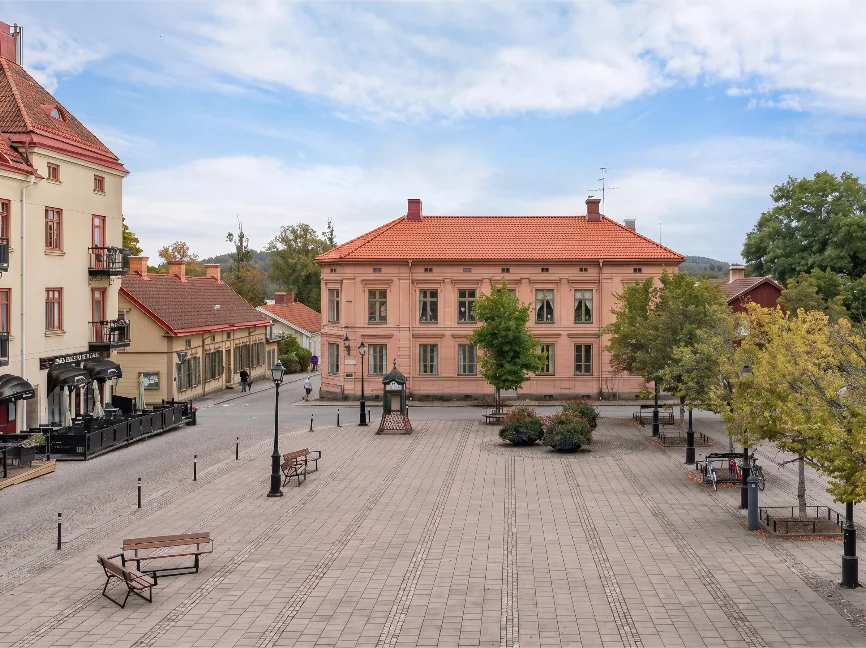
Central Nora is a national interest for cultural heritage, T 33: a small-town setting whose plan and small-scale wooden buildings express the Crown's town-founding policy in 1600s Bergslagen, and the structure and life of the pre-industrial town.
What is protected
The Swedish National Heritage Board names what carries the national interest: the grid plan, the plot structure, the courtyards and simpler buildings of the classic wooden town, the 1800s stone buildings, the railway station and its facilities, and Anders Wedberg's park, part of an 1878 extension plan. The national interest was reviewed again in March 2026. The County Administrative Board counts Nora, Eksjö and Hjo as Sweden's three best-preserved older wooden towns, and the three work together in the Three Wooden Towns network. Nora received the Europa Nostra award in 1993 for preserving the town, its industrial heritage and the railway to Pershyttan.
What the national interest means
In a national-interest area, heritage values outweigh conflicting interests. The County Administrative Board can overturn municipal decisions that do not take enough account of them. The municipality's comprehensive plan says new buildings in central Nora should fit the existing pattern and small scale, mainly with timber or stone façades, that care and maintenance must be careful, and that the views over Lake Norasjön should be kept. Building guidelines (byggnadsordning) for the town centre were adopted on 16 June 2010 – the same date the broker gives for the area regulations on the property Saturnus 3.
What the law asks of an owner
- No disfigurement (Planning and Building Act, chapter 8 section 13): a building that is particularly valuable from a historical, cultural-historical, environmental or artistic point of view must not be disfigured.
- Maintenance (8:14): maintenance must suit the surroundings and the building's values, and for particularly valuable buildings preserve them.
- Duty of care (8:17): alterations must be made carefully, respecting the building's character and values.
- Ancient monuments: groundworks within a registered ancient monument generally need the County Administrative Board's permission. The broker lists one ancient monument on Saturnus 3.
In practice
Building permits in Nora are handled by Samhällsbyggnad Bergslagen, Prästgatan 6 in Lindesberg (tel. +46 581-55 00 40, drop-in on Mondays 10–15). The local plans and area regulations that apply to a property are in the municipality's maps. If you plan to change a façade, windows, roof, colour or signs – or build in the courtyard – the advice is simple: talk to the permit office before you draw.
For residents the protection is part of the quality of life: the townscape stays. For an owner it is a condition to plan for from the start, and a value in itself – what makes the location attractive today cannot be built away tomorrow.
The houses and the architecture
What makes Nora Nora is not a single monument but the whole: low houses in timber and render along streets that follow a 1600s plan, with courtyards behind the gates.
The wooden town
The older buildings in central Nora are mostly timber: log or framed structures clad in boarding, painted Falu red, ochre and light colours. Most have one or two storeys and stand with their long side to the street. Behind the street houses lie the courtyards with their outbuildings and sheds – the structure the national interest describes, and which the County Administrative Board considers the core of the town since the rebuilding after 1731. The municipality has many old houses: 23% of all dwellings in Nora Municipality were built before 1931.
The stone buildings
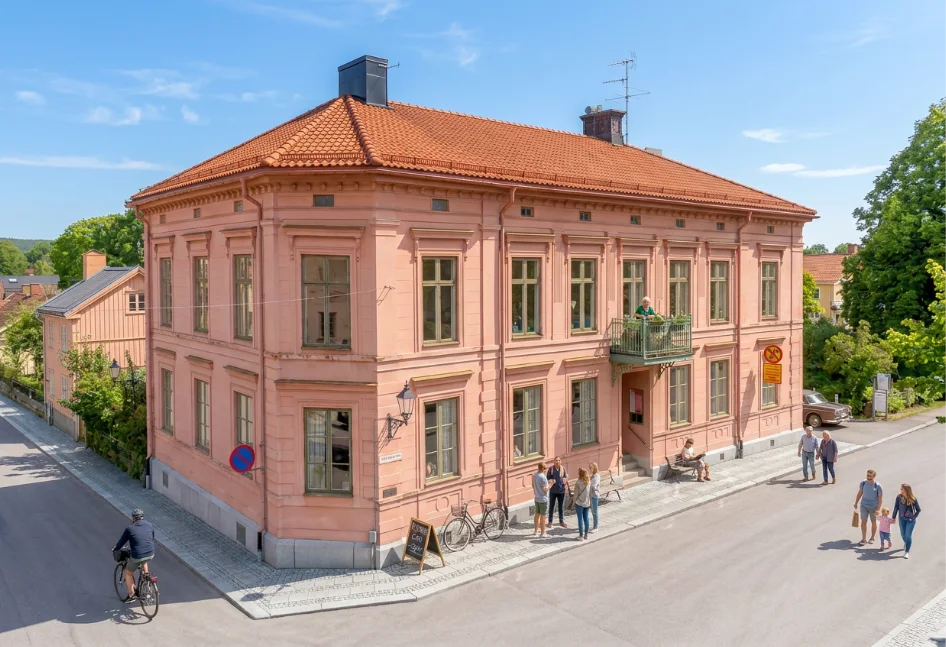
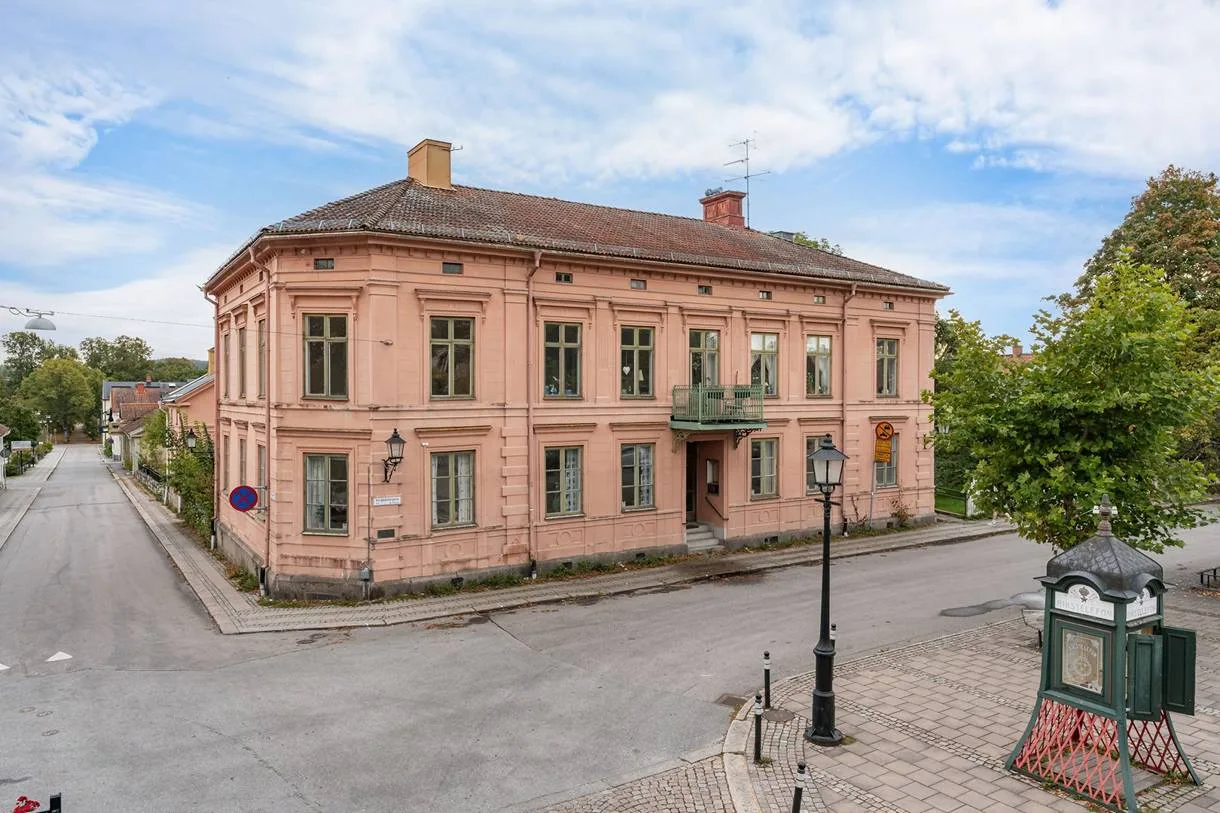
Around the square and along the main streets there are also rendered houses of stone or brick, often from the second half of the 1800s and the early 1900s. The national interest names the 1800s stone buildings specifically. The pink stone building at Borgmästargatan 5 belongs to this group: a rendered façade facing the square, and dormers and entrances on the courtyard side.
The courtyards
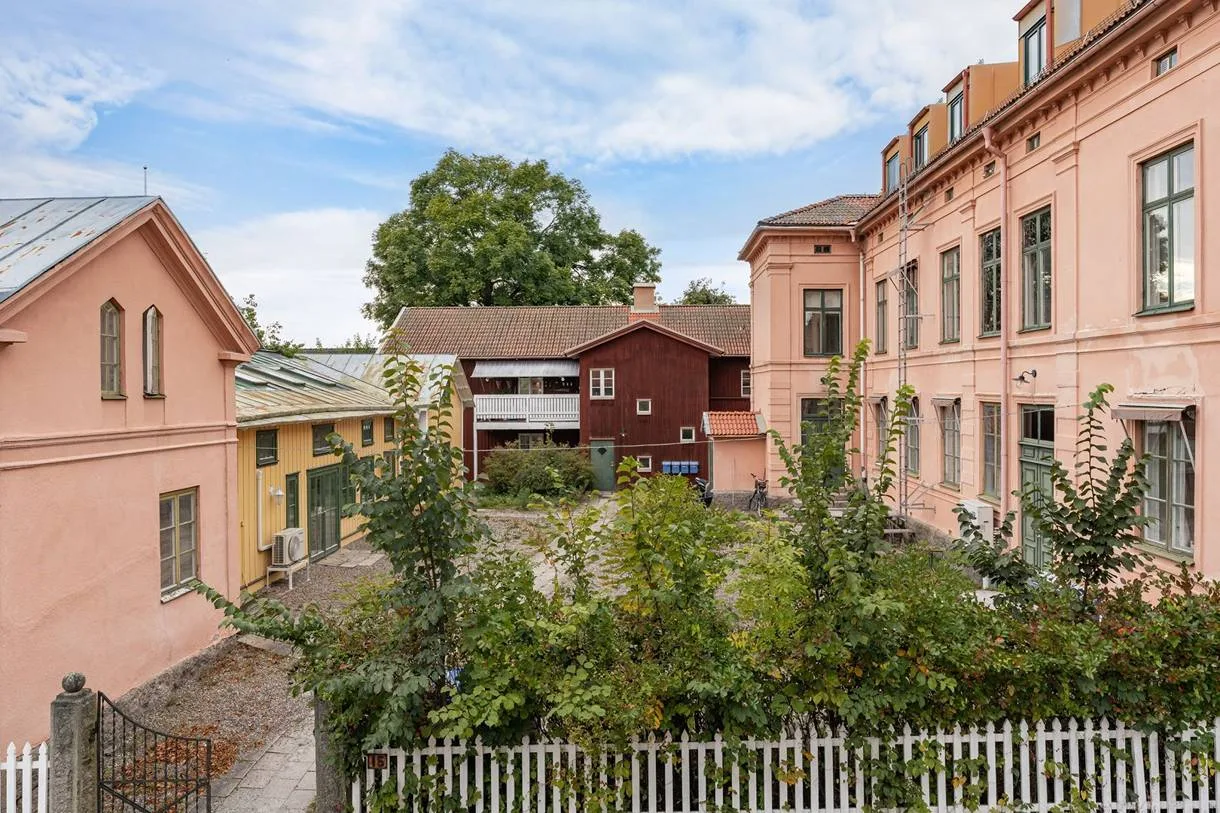
The courtyard is as much part of the townscape as the street. In the blocks around the square the courtyard houses stand close together, with gravel or paved yards, planting and fruit trees. For the owner of a rental property the courtyard is both an asset – seating, bicycle racks, growing space – and a matter of upkeep.
What an old building needs
Older timber and rendered buildings have their own maintenance needs. This is not a survey, but these are the items that usually decide the costs:
- Façades: timber boarding needs repainting at intervals, ideally with the same type of paint the house already has; render needs repair and limewashing.
- Windows: older windows can often be restored rather than replaced, and in a protected setting their appearance must be kept.
- Roof: ask when it was last relaid and what it is made of.
- Pipes and wiring: water, drains and electrics have a shorter life than the structure; ask when they were renewed.
- Heating: the heating system and insulation drive the largest running cost. At Borgmästargatan 5, heating is the largest cost in the prospectus.
Living in Nora today
A town centre where the square, the lake, the school and the health centre are close together, a job market that reaches to Örebro, and a calendar that follows the seasons.
- Local income tax 2026
- 34.55% (Swedish average 32.38%)
- Unemployment 2025
- 5.3%
- Active companies
- About 2,000
- Largest company
- Orica (detonators)
- Mean annual temperature
- 6.5 °C (Lindesberg, 1991–2020)
- January / July
- −2.6 °C / 17.2 °C
Work and business
Nora has about 2,000 active companies, almost 1,700 of them with fewer than five employees. The largest is Orica, which makes detonators for civil use; the municipality's list of its largest companies also includes Europrofil, Danfo, Älvstorps Vård- och Behandlingshem, SSE Sverige and the municipal housing company Norabostäder. Unemployment was 5.3% in 2025 – lower than in the county (6.8%) and in Sweden (7.0%). Many people commute to Örebro, and the National Board of Housing describes Nora as a commuter municipality near a larger city.
Tax
The combined local income tax is 34.55% in 2026 – 22.25% to the municipality and 12.30% to Region Örebro County – unchanged since 2024. That is above the national average of 32.38% and Örebro Municipality's 33.65%.
The year in Nora
- Noradagarna fills the town for four days in early July (1–4 July 2026; 7–10 July 2027).
- Noramarken, a market, at the end of August.
- Ljusstråk, an art and culture trail with about a hundred exhibitors, on the first weekend of September.
- Nora's Christmas market in December.
- NoraGlass, started in 1923 by Selma Gerdin, sells ice cream from its kiosk by the lake every day from mid-April to mid-September.
Climate
Nora has an inland climate with cold winters and mild summers. At the Swedish Meteorological Institute's station in Lindesberg, the nearest, the mean annual temperature was 6.5 °C over the 1991–2020 normal period, with −2.6 °C in January and 17.2 °C in July.
Schools and childcare
Six municipal compulsory schools and an independent one, preschools in the town and the villages, and a new lower-secondary school being built for autumn 2028.
Preschools
The municipality lists eight municipal preschools – Södra Haga, Gyttorp, Hagbyängen, Järnboås, Soltunet, Marstrandshagen, Sagoskatten and Lingården – and the independent Äventyret friförskola.
Compulsory schools
| School | Years | Location |
|---|---|---|
| Järntorgsskolan | F–6, with adapted school | Central Nora, Svartälvsgatan 18 |
| Lärkesskolan | F–6 | Hitorp |
| Ås skola | F–6 | About 3 km west of town |
| Gyttorpskolan | F–6 | About 5 km west; designed by Ralph Erskine in 1961 |
| Järnboås skola | F–6 | About 20 km north |
| Karlsängskolan | 7–9, health profile | Nora |
| Born friskola | F–6, independent | Nora Municipality |
The F–6 schools have after-school care (fritidshem). A new Karlsängskolan for years 7–9 is under way: its local plan came into force in May 2025, piling began in June 2026 and the municipality plans to open it for the autumn term of 2028.
Upper secondary
Nora has no national upper-secondary programmes of its own. Under cooperation agreements, students attend municipal upper-secondary schools in Örebro County or apply to independent schools; in Nora only the introductory programme is offered, at Gymnasieskolan Hjernet. Expect teenagers to commute – the bus to Örebro takes about 42 minutes.
Adult education
Hjernet at Malmgatan 4 offers municipal adult education (komvux), Swedish for immigrants (sfi), vocational adult education and adapted adult education.
Healthcare and care
A health centre and dental care in town, an emergency department at Lindesberg hospital and the university hospital in Örebro.
- Nora health centre
- Kvarnvägen 11, tel. +46 587-843 00, weekdays 8–17
- Public dental care
- Folktandvården Nora, Kvarnvägen 11, tel. +46 587-843 80
- Private dental care
- Mun i Form, Borgmästargatan 2 C
- Nearest emergency department
- Lindesberg hospital, about 25 km
- University hospital
- USÖ in Örebro, emergency 24/7
Nora health centre is run by Region Örebro County and includes child health care (BVC), a midwife, a psychologist, a physiotherapist and a laboratory. Public dental care is in the same building, and a private dentist contracted by the region is on Borgmästargatan, a stone's throw from the square.
For acute illness and injury there is the emergency department at Lindesberg hospital, open around the clock and the nearest by car, and the emergency department at Örebro University Hospital (USÖ) – where bus 401 also goes. Lindesberg is one of the county's three acute hospitals. Always call 112 in an emergency, and 1177 for medical advice.
Commuting and travel
The bus to Örebro runs often on weekdays. From there you reach trains to Stockholm and Gothenburg, and flights from Örebro Airport.
- Örebro
- About 32–35 km; car about 35 min; bus 401 about 42 min
- Lindesberg
- About 25 km, car about 26 min
- Karlskoga
- About 43 km, car about 50 min
- Stockholm
- About 230 km, car just under 3 hours
- Örebro Airport
- About 48 km, car about 45 min
Bus 401
Länstrafiken's regional bus 401 runs between Nora station and Örebro's travel centre in about 42 minutes and continues to the university hospital. On weekdays there are about 31 departures from Nora, every 15 minutes at peak times; five on Saturdays and four on Sundays (autumn 2026 timetable). Regional buses also run from Nora towards Lindesberg and Hällefors. Always check current times with Länstrafiken Örebro.
By car
National road 50 crosses the municipality from north to south. County road 243 runs west towards Karlskoga and Hällefors, and county road 244 east to road 50, Lindesberg and Örebro. Örebro is about half an hour by car, depending on where you are going.
Trains and flights
Nora has had no passenger trains since 1966. Trains to Stockholm, Gothenburg and the rest of Sweden leave from Örebro, and Örebro Airport is just under 50 km away.
Remote work
If you work from home a few days a week, the commute matters less. Check the broadband at the address you are interested in.
Nature, culture and leisure
The lake by the square, an island with a beach, a mining village, a heritage railway and one of Sweden's longest hiking trails – all within a few kilometres of the town centre.
Lake Norasjön and Alntorp Island
Lake Norasjön lies right next to the town centre, with walks along the water. Alntorp Island was given to the town in 1926. You get there on the boat M/S Plaskus, which is free and leaves from the station area every hour and half hour from 10.00 to 17.30, June to mid-September; the trip takes about ten minutes. The island has a beach with a diving tower, a kiosk, mini golf, a gene bank of fruit trees, a 3 km trail and camping pitches.
Swimming
The municipality's bathing places are Alntorp Island, Blåsut – a ten-minute walk from the centre – and Käppsta on Lake Vikern near Gyttorp. There is also swimming at Finnsjön in Järnboås, Öskeviksbadet and Uskavi on Lake Usken.
Pershyttan
The mining village of Pershyttan has one of Sweden's best-preserved charcoal furnaces, with the furnace, mine, water wheel, rod drive and charcoal house all preserved. A 6 km nature and heritage trail, marked in yellow, tells the village's story. Guided walks run in season, and groups book tours May–September through Nora tourist office (tel. +46 587-811 20).
The heritage railway
Nora Bergslags Veteran-Jernväg runs steam trains and railbuses on the old line in summer: in summer 2026, among other things, steam trains to Järle at weekends and railbuses to Pershyttan on Saturdays in July. The railway museum in the goods shed at the station opens May–September, and the tourist office is in the station building from 1900.
Göthlinska gården
Agathon and Augusta Göthlin bought the house in 1886. Their daughter Ingrid left it in her will on condition that nothing be changed, and since her death in 1961 it has been owned by the foundation Ingrid Göthlins Minne. The interior is from the late 1800s, and the house has been a listed building since 2007.
Hiking, skiing and golf
- Bergslagsleden, 280 km in 17 stages, passes just outside Nora on stages 4–7, including Hammarby–Pershyttan (15 km) and Pershyttan–Mogetorp (15 km).
- Digerberget, just south of town, has about 5 km of floodlit ski tracks and a sledging hill; the 27 km Kilsbergsspåret trail to Ånnaboda starts here.
- Nora Golfklubb lies at Östra Sund on Lake Norasjön.
Other sights in the municipality include the Siggebohyttan miner's farm from 1790 and Järnboås with its timbered 1600s church.
Housing and the rental market
A municipality with many old houses, few new ones, a municipal housing company with a queue – and rents and house prices below the county's.
- Dwellings 2025
- 5,305
- Rental / co-op / owner-occupied
- 38.7 / 7.0 / 54.3%
- Built before 1931
- 23% of dwellings
- Median rent 2026
- SEK 1,228/m² a year (county 1,435)
- House, average price 2025
- SEK 2,049,000 (90 sold)
- Co-op flat 2025
- SEK 7,181/m² (few sales)
The housing stock
Nora Municipality had 5,305 dwellings at the end of 2025. Just over half (54.3%) are owner-occupied, 38.7% rental and only 7.0% co-operative flats (bostadsrätter) – nationally co-ops are almost a quarter. 63.7% of dwellings are in houses and 30.2% in apartment buildings. Little has been built: no new flats in apartment buildings were completed in 2023–2025, and just one new house in 2025. The municipality has plots and projects under way, including 20 house plots at Stensnäs stage 3, 26 co-op terraced and semi-detached houses at Klotstigen (OBOS) and areas north of the town at Fåsjö Park and Åkerby.
The rental market
The municipal housing company is Norabostäder AB (Änggatan 11, tel. +46 587-813 10). Its stock ranges from 1600s houses to new builds, though most date from the 1960s onwards. Homes are let through a queue that earns one point a day; applicants need a net income of at least twice the rent. Norabostäder raised rents by 3.98% from 1 April 2026, about SEK 270 a month for an average 65 m² flat.
According to Statistics Sweden, the median rent in Nora was SEK 1,228 per square metre a year in 2026, including heating and water – lower than in Örebro County (1,435) and Örebro Municipality (1,539). For a landlord this means two things: residential rents are set by utility value (bruksvärde), not freely, and they sit at a level where a calculation should rest on actual rents, not on hoped-for increases.
House prices
In 2025, 90 houses for permanent living were sold in Nora at an average price of SEK 2,049,000, up from 1,862,000 the year before. On average the price was 1.49 times the tax assessment value. Co-op flats are few and their prices swing: Svensk Mäklarstatistik gives SEK 7,181 per square metre for 2025 and 9,068 for 2024.
Rental buildings in the county
For comparison, for investors: in Örebro County, 15 rental buildings with both homes and commercial space (type code 321) were sold in 2025 at an average price of SEK 15,916,000 and an average of 1.39 times the tax assessment value. 13 residential-only rental buildings (type code 320) sold for an average of SEK 7,465,000. The figures cover the whole county, Örebro included, and say nothing about a single building – but they give a frame.
If you are …
Room, lake and school – within commuting distance
Nora offers what many families look for outside the big cities: preschools and schools in the municipality, a health centre with child health care, lake and forest on the doorstep, and Örebro's job market about 42 minutes away by bus, every 15 minutes at peak times. The town centre is small enough for children to walk to most things, and the lake is by the square.
What differs from a larger city is the distance to the specialised: the municipality has no national upper-secondary programmes of its own, and the nearest emergency department is in Lindesberg. Expect teenagers to commute.
A route more families now consider is owning a small rental building and living in one of its apartments, so that rent from the others carries much of the cost. It means you want to be a landlord, and existing tenants keep their leases and strong security of tenure – you cannot count on a particular apartment becoming free.
Start with four numbers
A building with ten apartments and one commercial unit is easy to grasp in full: you can understand every lease and every cost. Start with four terms: rental value (what it brings in), operating and maintenance (what it costs to run), net operating income (what remains before interest and tax) and initial yield (net operating income divided by the price).
For Borgmästargatan 5 the broker states SEK 758,438, 326,531 and 431,907 – the arithmetic adds up. No price is given, so the yield depends on what you pay: about 6.2% at SEK 7 million, 5.4% at 8 million and 4.8% at 9 million (a worked example, not a valuation).
What the prospectus leaves out is what you need to ask about: the rent roll, the actual costs, the condition of the buildings and whether the property is sold directly or as a company. Bring in the bank early – it decides how much you can borrow and on what terms.
The unit, the heritage and the costs
The commercial unit: 250 m² bringing in SEK 155,152, about a fifth of the rental value. Read the lease, its term, the indexation clause and the tenant's business; a vacancy in the unit hurts more than an empty flat.
The costs: heating is the largest item (SEK 118,256), maintenance is an allowance of SEK 100 per m², and the property tax and fee (SEK 35,890 per the fact box), administration and vacancy sit outside the prospectus net operating income. The assessment: two units and two different figures for the assessed value in the listing. The market: the median rent in Nora is SEK 1,228 per m² a year; the prospectus rental value for the whole building is 777.
The heritage: the area regulations frame façade, windows and roof and so any value-add – but they also guarantee a lasting townscape, and a location on the square that cannot be built away.
250 m² where the town meets
The commercial unit at Borgmästargatan 5 is 250 m², listed as an office, on the square at the heart of the old town – visible and easy to find, in a town that fills with visitors during Noradagarna, Noramarken and the summer weeks.
If you are thinking of owning the building and using the unit yourself, first check whether it is let today and on what terms: a valid lease passes with a sale. A change of use – from office to shop, café or housing – may need a building permit and is judged against the area regulations; so are signs and façade changes.
Small, walkable – and honest about it
Nora is small: most of the town centre is within walking distance, the lake is by the square and the forest starts where the town ends. That also means fewer shops, no upper-secondary programmes of its own and further to hospital than in a city, and public transport built around the bus to Örebro.
What you gain is time, space and a townscape protected for the future – and housing prices far below the big cities': a house cost an average of SEK 2,049,000 in 2025. Try everyday life before you decide: a week in November tells you more than a weekend in July.
Everything close by, and a building that pays its way
Almost three in ten Nora residents are 65 or over. Many people leaving working life look for what Nora has: a town centre where the square, the lake, the health centre and the cafés are all within walking distance, and a calmer pace.
Owning a rental building can add income – but a building needs management, and management takes either your own time or a property manager who costs money. Think through how long you want to own, who will look after the building if you no longer can, and how a future sale would work.
The same purchase, different conditions
The rules around a Swedish rental building – the tenancy law, the utility-value rent system, stamp duty, the property fee and the rules for buying a company – differ from many other countries'. Residential rents are not set freely, and tenants have strong security of tenure.
Expect to need a bank with Swedish property experience, a Swedish accountant, a lawyer for the contracts and a property manager on site. This guide is also available in Swedish, through the language switch at the top.
The building on the square
Borgmästargatan 5
- Total floor area
- 976 m²
- Apartments
- 10 · 726 m²
- Commercial unit
- 250 m²
- Plot
- 1,264 m²
- Net operating income
- SEK 431,907 a year
- Price
- On request
The property in detail
Nora Saturnus 3 is a small block in itself: three buildings, six addresses, ten apartments, a commercial unit and a courtyard on a 1,264 m² plot, directly south of the square.
- Property designation
- Nora Saturnus 3
- Addresses
- Borgmästargatan 5, Kungsgatan 15 A–E
- Buildings
- 3 (built 1929, 1929 and 1991)
- Residential
- 10 apartments, 726 m²
- Commercial
- 1 unit (office), 250 m²
- Total floor area
- 976 m²
- Plot
- 1,264 m²
- Tax units
- Small-house unit (220) and rental unit (321)
- Planning
- Area regulations 16 June 2010; one ancient monument
- Energy certificate
- Not stated in the listing
The buildings
Facing the square and Borgmästargatan is a pink rendered stone building with dormers and entrances on the courtyard side. On the plot stand a red and a yellow timber house around a gravelled courtyard with paved paths, seating, planting and fruit trees, with a white fence along Kungsgatan. The prospectus gives the construction years 1929, 1929 and 1991 but not which building has which year – one of the first questions to ask, since the answer affects the maintenance needs.
The apartments
According to the prospectus the ten apartments measure 105, 95, 94, 49, 57, 71, 57, 71, 57 and 70 m² – an average of just under 73 m². The number of rooms, their place in the buildings, rents and leases are in the rent roll, which the broker provides on request.
The commercial unit
The unit is 250 m² and listed as an office. It accounts for SEK 155,152 of the rental value, about a fifth. For a buyer the commercial lease is therefore one of the key documents: who rents, at what rent, for how long and on what terms for termination and renewal.
Two tax units
The property is assessed as two units: a built small-house unit (type code 220, a building for one or two families) and a rental unit with homes and commercial space (type code 321). The prospectus gives assessed values of SEK 1,959,000 and 8,057,000 for 2024 and a total of 10,038,000 – although the two units add up to 10,016,000. The broker's fact box instead gives assessment year 2022 and a total of 10,598,000, of which building 10,038,000 and land 560,000. Rental buildings are assessed every three years – a general assessment in 2025, a simplified one in 2028 – so ask for a current extract from the property register; the assessed value affects both the property fee and, in a direct purchase, the stamp duty.
The numbers step by step
The prospectus adds up: rental value minus operating and maintenance costs gives the net operating income. But net operating income is the start of the calculation, not the end.
- Rental value
- SEK 758,438 a year (777/m²)
- – residential
- SEK 603,286
- – commercial
- SEK 155,152
- Operating and maintenance 2023
- SEK 326,531 a year (335/m²)
- Net operating income
- SEK 431,907 a year
- Property tax and fee
- SEK 35,890 (fact box)
- Mortgage deeds
- 6, SEK 12,375,000
- Price
- On request
The costs line by line
| Item | SEK a year | SEK per m² |
|---|---|---|
| Heating | 118,256 | 121 |
| Maintenance (allowance SEK 100/m²) | 97,600 | 100 |
| Water and drains | 49,287 | 50 |
| Electricity | 42,502 | 44 |
| Insurance | 11,052 | 11 |
| Cleaning | 7,834 | 8 |
| Total | 326,531 | 335 |
Heating is the largest item – over a third of the costs – so the heating system and the energy certificate are key documents. Maintenance is an allowance of SEK 100 per m², not an actual cost: the real need depends on the condition of the buildings.
The rents against the market
The prospectus rental value equals SEK 777 per m² for the whole building; the residential part is about 831 per m² and the commercial unit about 621. Statistics Sweden's median rent for rental apartments in Nora was SEK 1,228 per m² a year in 2026. The figures are not directly comparable – the rental value may be calculated differently, and rents depend on the size and standard of the apartments – but the gap is a question worth asking, and the rent roll answers it.
Property fee and property tax
For the homes the owner pays the municipal property fee: 0.3% of the residential assessed value, capped at SEK 1,784 per apartment in 2026. For the commercial unit the state property tax is 1% of the commercial assessed value. For a small-house unit the fee is 0.75% of the assessed value, capped at SEK 10,425 in 2026. The broker's fact box gives SEK 35,890 for the property. The fee is paid by whoever owns the property on 1 January, for the whole year. The prospectus net operating income leaves it out – and administration, management and vacancy too. With SEK 35,890 deducted, net operating income is SEK 396,017.
The yield at different prices
Initial yield is net operating income divided by the price. Since the listing gives no price, the table shows the yield at different prices – a worked example, not a valuation.
| If the price is | Price per m² | On the prospectus NOI | After property fee |
|---|---|---|---|
| SEK 7,000,000 | SEK 7,172 | 6.2% | 5.7% |
| SEK 8,000,000 | SEK 8,197 | 5.4% | 5.0% |
| SEK 9,000,000 | SEK 9,221 | 4.8% | 4.4% |
| SEK 10,000,000 | SEK 10,246 | 4.3% | 4.0% |
A worked example with a loan
Assume a price of SEK 8 million, a private individual buying the property directly, and a bank lending 60%. All assumptions are ours and only examples – the price is set by the market, the loan terms by the bank. The Riksbank's policy rate is 1.75% (decision of September 2026); a loan for a rental building costs more than that, and we use three interest rates.
| Item | Amount |
|---|---|
| Purchase price (assumed) | SEK 8,000,000 |
| Loan, 60% (assumed) | SEK 4,800,000 |
| Own capital | SEK 3,200,000 |
| Stamp duty 1.5% on the assessed value of SEK 10,038,000 | SEK 150,570 |
| Title registration fee | SEK 825 |
| New mortgage deeds | SEK 0 – the existing SEK 12,375,000 is enough |
| Total own capital | SEK 3,351,395 |
Stamp duty is charged on the higher of the purchase price and the assessed value for the year before title is granted. If the assessed value is higher than the price – as in the example – it becomes the base. If a company buys the property directly the duty is 4.25%, SEK 426,615 in the example.
| Interest (assumed) | Interest cost | Left after interest* | Interest cover | On own capital |
|---|---|---|---|---|
| 3.5% | SEK 168,000 | SEK 228,017 | 2.4 | 6.8% |
| 4.5% | SEK 216,000 | SEK 180,017 | 1.8 | 5.4% |
| 5.5% | SEK 264,000 | SEK 132,017 | 1.5 | 3.9% |
* Net operating income after the property fee (SEK 396,017) minus interest – before amortisation, administration, vacancy, extra maintenance and tax. Interest cover is net operating income divided by the interest cost. Sweden's financial supervisor treats interest cover below 1 together with a loan-to-value above 70% as a sign of a vulnerable property company; the example is far from that, but it shows how sensitive the numbers are to the interest rate.
Direct purchase or company
A rental building can be bought in two ways: the property directly, or the shares in the company that owns it. The choice affects stamp duty, the price, tax over time and what you need to examine. The listing for Borgmästargatan 5 does not say which applies – ask the broker early.
Direct purchase
In a direct purchase the property changes hands and the buyer applies to Lantmäteriet (the land registry) for title within three months. Stamp duty is 1.5% for private individuals and 4.25% for companies, on the higher of the price and the previous year's assessed value, plus a SEK 825 registration fee. New mortgage deeds cost 2% of the amount plus SEK 375 per deed; existing deeds stay with the property. Buyer and seller are jointly liable for the stamp duty.
Buying the company
In a company purchase you buy the shares in the limited company that owns the property. The property has the same owner as before – the company – so no new title is registered and no stamp duty is charged. For a selling company the gain on the shares is usually tax-free, because unlisted shares held by a limited company count as business-related holdings (näringsbetingade andelar). That is why many rental buildings are sold as companies.
The price is negotiated as an underlying property value; the price of the shares becomes that value plus the company's other assets, minus its debts, and often adjusted for deferred tax. Deferred tax arises because the property has a lower tax value in the company than its market value – the buyer takes over the lower value and with it a future tax, and smaller depreciation. How it is shared between buyer and seller is a matter for negotiation.
Company sales have long been debated. A government inquiry (SOU 2017:27) proposed that properties in a company should be treated as sold at market value when the company changes hands, and that stamp duty for companies should fall to 2%. The proposal has not been enacted: in October 2026 the rate is still 4.25%, and no such rule exists in the Income Tax Act.
Owning as a private individual
A rental building owned directly is a business property, and the income is taxed as business income. If you spend at least a third of a full-time job on managing it, the business normally counts as active, with social charges of 28.97%; otherwise passive, with a special payroll tax of 24.26% (2026). On a sale the gain is taxed as capital income – 90% of the gain at 30%, in effect about 27% – and earlier depreciation and deducted improvements are clawed back. If you live in one of the apartments yourself, you book a market rent as income in the business.
Owning through a company
A limited company pays 20.6% corporate tax. The building is depreciated by a yearly percentage based on its life – for residential rental buildings usually 2% a year – and repairs and maintenance are deducted at once, while improvements are added to the depreciation base. A company may deduct a net interest expense up to 30% of its taxable earnings before interest and depreciation, or up to SEK 5 million. If an owner lives in one of the company's apartments, special rules apply to the benefit and, in a closely held company, to a later sale.
This is an overview, not tax advice. Buying a rental building – especially as a company – should be done with an accountant and a lawyer.
Tenants and rents
When you buy a rental building you also take on its tenants: the leases follow the building, residential tenants have strong security of tenure, and rents are set by utility value.
The leases follow the building
A written lease is valid against a new owner if the tenant moved in before the sale (Land Code, chapter 7 section 13). You take over every apartment and the commercial unit with the leases in force today.
Security of tenure
A residential tenant generally has the right to stay even if the landlord gives notice. The grounds that can override this are listed exhaustively in the law (chapter 12 section 46) – for example the tenant's misconduct, demolition or major rebuilding, or other objective reasons. If the tenant disputes a notice, the landlord must take it to the rent tribunal (hyresnämnden). The notice period is three months for a home and nine for commercial premises. For anyone hoping to live in one of the apartments this means: count on an apartment that is or becomes free, not on a tenant moving out.
How rents are set
Residential rents follow the utility-value principle (bruksvärde): a rent is not reasonable if it is noticeably higher than the rent for apartments of equal utility value (12:55). A landlord who regularly lets more than two apartments is covered by the Rent Negotiation Act, and where the leases have a negotiation clause, rents are negotiated with the Swedish Union of Tenants. A party wishing to change the rent must notify the other in writing; if they cannot agree, the question can go to the rent tribunal.
Rent increases in the county
- For private landlords in Nora and other towns, the 2024 rents were set by an arbitrator: +5.2% from 1 April 2024.
- For 2025 the increase was 5–5.1% in most of the county's municipalities with private landlords.
- Norabostäder raised rents by 3.98% from 1 April 2026; nationally the 2026 negotiations averaged 3.4%.
Presumption rents – for newly built apartments – got new rules on 1 January 2026, but do not apply to the buildings on Saturnus 3.
Renovation and the tenants
Work that raises the standard or substantially changes an apartment needs the tenant's approval or the rent tribunal's permission; bringing it up to the lowest acceptable standard does not. The landlord must give written notice and may apply to the tribunal two months later at the earliest. A rise in utility value made without approval may not affect that tenant's rent for five years.
The commercial tenant
A commercial tenant has indirect security of tenure: if the landlord ends the lease after more than nine months, the tenant may be entitled to compensation of at least one year's rent plus proven loss. The tenant must then turn to the rent tribunal within two months. The protection can be waived in a separate agreement. Read the commercial lease with this in mind.
Value-add and maintenance
The broker highlights good value-add potential. In a protected town centre, with tenants who stay, adding value takes patience – but the tools are clear.
Within the rules
Saturnus 3 is covered by area regulations and the municipality's building guidelines. Façade changes, extensions and new building on a building protected in area regulations – or one that is particularly valuable – need a building permit (Planning and Building Act 9:37), and the bans on disfigurement and the duty of care apply. Adding value here is therefore more often about caring for and improving what exists than about building new. The permit rules changed on 1 December 2025; ask Samhällsbyggnad Bergslagen what applies to your idea.
Possible routes
- The commercial unit: 250 m² on the square. A new or extended lease, or a change of use, affects a fifth of the rental value. A change of use may need a permit.
- Energy: heating is the largest cost. An energy certificate shows the buildings' energy use and suggests measures; measures that cut running costs raise net operating income directly.
- Standard: renovations that raise an apartment's standard can justify higher rents under the utility-value system – but need the tenants' approval or the rent tribunal's permission.
- The courtyard: a courtyard with fruit trees is a quality for tenants and for the townscape; upkeep and outdoor space affect how long tenants stay.
- The plot: 1,264 m² is a large plot for the town centre. What may be built is decided by the area regulations, the building guidelines and the ancient monument – ask the municipality before you count on it.
Energy certificate, ventilation and radon
- Energy certificate: a building must have a valid energy certificate when it is sold and when it is let. It is valid for ten years, and the seller is responsible for providing it and handing it to the buyer. New rules apply from 1 October 2026, and from 2030 energy requirements apply to existing commercial buildings. The listing for Borgmästargatan 5 gives no energy certificate – ask for it.
- Ventilation inspection (OVK): every third year for apartment buildings with mechanical supply and exhaust (FT, FTX), every sixth year with natural or exhaust ventilation.
- Radon: in a rental building the owner is responsible for measuring. The reference level is 200 becquerels per cubic metre; measurement runs for at least two months between October and April.
Tax on maintenance
Repairs and maintenance are deducted in the year they are done. Work that substantially changes the building counts as improvement and is depreciated over time. New building, extension and rebuilding of a rental building also give a so-called primary deduction. Where the line falls is a question for your accountant.
From interest to completion
Buying a rental building is like buying a house – broker, viewing, bids and contract – but with tenants, more documents and sometimes a company to examine.
- The documents. Ask for the prospectus, rent roll, several years of operating costs, an extract from the property register, the energy certificate, maintenance records and – for a company sale – the company's annual accounts. Note that the property register does not always show older easements.
- The bank. Talk to the bank early. It assesses both the property and you, and decides the loan-to-value, interest and amortisation. Sweden's housing credit act of 1 April 2026 – with a 90% loan-to-value cap and amortisation rules – is written for loans for homes; whether and how it applies to a company's loan for a rental building is for the bank to decide.
- The viewing. No viewings are scheduled; book one with the broker. Look at the roof, attic, basement, heating, pipes, shared spaces, the courtyard and if possible apartments and the commercial unit – with consideration for the tenants.
- The survey. The buyer has a duty to inspect: you cannot rely on defects a reasonable inspection would have revealed (Land Code 4:19). Hire a surveyor.
- The bidding. Bidding is not regulated by law. A bid binds no one – not even in writing. The seller chooses freely who may buy.
- The contract. The purchase becomes binding when both parties have signed a deed stating the price and that the property is transferred (4:1). In a company sale a share purchase agreement is signed. Terms left out of the deed that make the purchase conditional or limit the seller's liability are invalid.
- The deposit. Usually about 10% of the price, within a week or so of signing. No law sets the amount.
- Completion. The rest is paid and the property – or the company – is taken over. The seller hands over the energy certificate; if there is none, the buyer may have one made at the seller's cost within six months.
- Title. In a direct purchase, title is applied for at Lantmäteriet within three months, with the original deed in which the seller's signature is witnessed by two people. From 1 July 2026 the buyer's personal or company number is required, and a company must have its beneficial owner registered. Stamp duty is paid when title is granted.
- Ownership. Rent invoicing, insurance, supplier contracts, fault reporting and management – and the property fee, paid by whoever owns the property on 1 January.
Before you decide
- 01The rent roll: rent, area, lease and any vacancies for each apartment and the commercial unit.
- 02The commercial lease: tenant, term, rent, index and terms for termination and renewal.
- 03The operating costs: actual costs over several years, and what the maintenance allowance amounts to in reality.
- 04The buildings: which building has which construction year, and what major works – roof, pipes, windows, wiring, heating – have been done and when.
- 05The energy certificate and the heating system: heating is the largest cost.
- 06A survey by a qualified surveyor, focusing on roof, damp, wiring, heating and pipes.
- 07The property register: owner, registrations, mortgage deeds, easements, plans and the current assessed value.
- 08The area regulations and building guidelines: what they mean for what you want to change – ask Samhällsbyggnad Bergslagen.
- 09The ancient monument: where it is and what it means for groundworks on the plot.
- 10The form of purchase: direct or company, and if a company, its accounts, debts and deferred tax.
- 11Financing: the bank's view of the property and the town, loan-to-value, interest and amortisation.
- 12Management: who handles tenants, fault reports, cleaning and maintenance – and what it costs.
- 13Insurance: what the current policy covers and what a new one costs.
- 14Your own calculation: with the property fee, administration, vacancy, interest and realistic maintenance.
Questions and answers
Is Nora a good place for a family?
The municipality has preschools, five F–6 schools, a lower-secondary school (being rebuilt for 2028), an independent school and a health centre with child health care, with lake and forest close by. Upper secondary is in Örebro or neighbouring towns, and the nearest emergency department is in Lindesberg.
How long is the commute to Örebro?
Bus 401 takes about 42 minutes from Nora station to Örebro's travel centre and runs every 15 minutes at weekday peaks. By car it is about 33 km, roughly half an hour.
Is there an upper-secondary school in Nora?
No national programmes. Students attend municipal upper-secondary schools in Örebro County under cooperation agreements, or apply to independent schools. Nora offers the introductory programme at Hjernet.
Where is the nearest hospital?
The nearest emergency department by car is at Lindesberg hospital, about 25 km away, open around the clock. Örebro University Hospital also has a 24-hour emergency department.
What does a house in Nora cost?
Houses sold for an average of SEK 2,049,000 in 2025 (Statistics Sweden), 1.49 times the assessed value. Co-op flats are few; Svensk Mäklarstatistik gives SEK 7,181 per m² for 2025.
How long is the queue for a rental flat?
Norabostäder lets through a queue in which you earn one point a day. How long it takes depends on the area and size you want; ask Norabostäder, tel. +46 587-813 10.
Can you renovate a building in Nora's old town?
Yes, within the area regulations, the building guidelines and the Planning and Building Act's duty of care and ban on disfigurement. Building permits are handled by Samhällsbyggnad Bergslagen in Lindesberg – contact them early.
What does T 33 mean?
It is the code for the national interest for cultural heritage Central Nora in Örebro County. It covers the town centre's plan, plots, courtyards and buildings.
What does Borgmästargatan 5 cost?
The listing gives no price; contact Erik Lejon at Lejons Mäkleri, +46 70-999 29 90. Worked examples of the yield at different prices are in the chapter on the numbers.
What does the building yield?
The broker gives net operating income of SEK 431,907 a year. The initial yield depends on the price: about 6.2% at SEK 7 million, 5.4% at 8 million and 4.8% at 9 million (a worked example before property fee, administration and vacancy).
Can I live in one of the apartments myself?
An owner can live in an apartment that is or becomes free. Existing tenants keep their leases and strong security of tenure, so an apartment cannot be taken over just because the building changes hands.
Can the commercial unit be used for something other than an office?
A change of use may need a building permit and is judged against the area regulations. First check whether the unit is let and on what terms – a valid lease passes with a sale.
Is the building sold directly or as a company?
The listing does not say. Ask the broker early: the answer affects stamp duty, the price, tax and what needs examining.
Are there viewings?
None are scheduled; book a viewing directly with the broker through the request form or on +46 70-999 29 90.
Sources
The property details come from Lejons Mäkleri's listing, property page and prospectus. Statistics are from Statistics Sweden's database (population, urban areas, housing stock, rents, property prices and local tax), Kolada and Svensk Mäklarstatistik; travel times and distances are approximate. All retrieved in October 2026. Worked examples are our own and are not valuations. This is general information, not financial, legal or tax advice.
Questions about Nora or the building on the square?
Request the rent roll, the financials and a viewing – or call the responsible broker, Erik Lejon, directly.